Fragmentation of international trade: a new division of relations between States
This new dynamic, often described as fragmentation, now favors security of supplies and political alliances, at the risk of calling into question the achievements of globalization. The Directorate General of the Treasury proposes, in a note published at the beginning of November, a measure of this fragmentation.
A geopolitical reconfiguration of exchanges
This trend towards fragmentation is materialized by a profound change in trade flows. Recent data highlights an intensification of trade between countries sharing the same strategic alliances, to the detriment of relations with rival blocs. This phenomenon, sometimes called friendshoring, illustrates the desire of public authorities to direct trade towards partners deemed more secure, using both positive incentives, such as targeted trade agreements, as well as sanctions or tariff barriers.
Trade dynamics
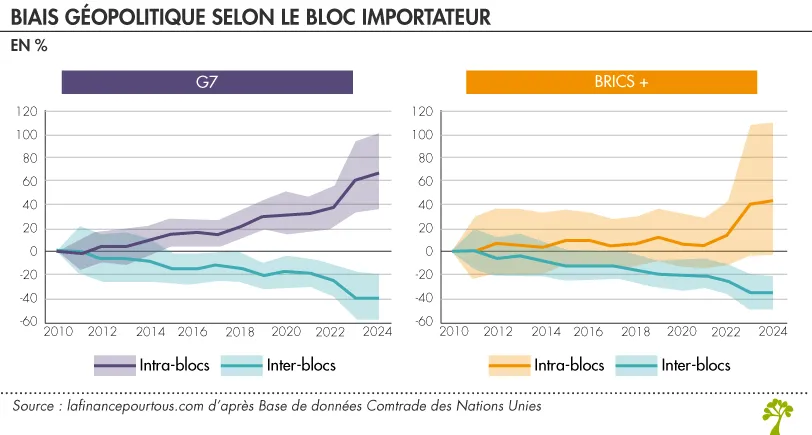
Consider two blocs, the G7+ (made up of the major Western economies) and the BRICS+ (made up of the major economies of the “Global South”).
For each bloc, we can measure the evolution of imports between the countries of the bloc (intra-blocs), and of imports from the countries of the rival bloc (inter-blocs). (See picture)
Between 2010 and 2024, imports from G7+ countries increased by approximately 60% from other G7+ countries and decreased by 40% from BRICS+ countries Russia. In other words, trade within the bloc boomed, while trade with the other bloc plummeted. A similar dynamic can be observed for the BRICS+ bloc.
These results are confirmed if we focus on other definitions of the two blocs: allies of the United States vs. allies of Russia, or supporters of Ukraine vs. supporters of Russia.
If this strategy aims to reduce dependence on countries deemed hostile, it is not without consequences on the very structure of the world economy. The logic of blocs, schematically opposing an expanded “West” to an alternative axis, tends to rigidify commercial relations. Where companies previously sought the most competitive supplier, they must now integrate geopolitical risk as a central variable in their equation, which inevitably leads to a less optimal allocation of resources than in a situation of total free trade.
The price of fragmentation
The recomposition of trade has a significant macroeconomic cost. Historically, globalization has allowed, thanks to the specialization of countries and economies of scale, a reduction in the prices of consumer goods and an increase in the variety of products available. By fragmenting the global market, we mechanically expose ourselves to a loss of efficiency. Companies, forced to relocate their production or change suppliers for political reasons, face higher production costs.
This increase ultimately has repercussions on prices, fueling inflationary pressures, and production.
Above all, fragmentation indirectly increases political tensions. Two countries or blocs whose economies are very integrated have a very high cost of entering into a political crisis, or even war. “Sweet commerce” acts as a reminder towards greater measure. If decoupling between blocks persists, then the economic cost of tensions between blocks diminishes. More tensions, therefore even more decoupling, therefore constitute even less restoring force.
Decoupling or reorganization?
However, it is appropriate to qualify the reality of this decoupling. The example of Sino-American relations is enlightening in this respect. While direct US imports from China have statistically declined in recent years, from over 20% to around 14%, real economic dependence remains high. We are indeed seeing a concomitant increase in American imports from third countries, such as Vietnam or Mexico, which themselves have increased their trade with China.
This suggests, as a nuance of decoupling, a reorganization of circuits: Chinese products continue to enter the American market, but after having transited or been assembled in “intermediate” countries. This persistence of indirect links shows the difficulty of unwinding decades of economic integration and underlines that fragmentation, if it is very real politically, clashes with the complexity of industrial value chains.