How Uganda exports nearly 5 billion euros of gold without being a major producer
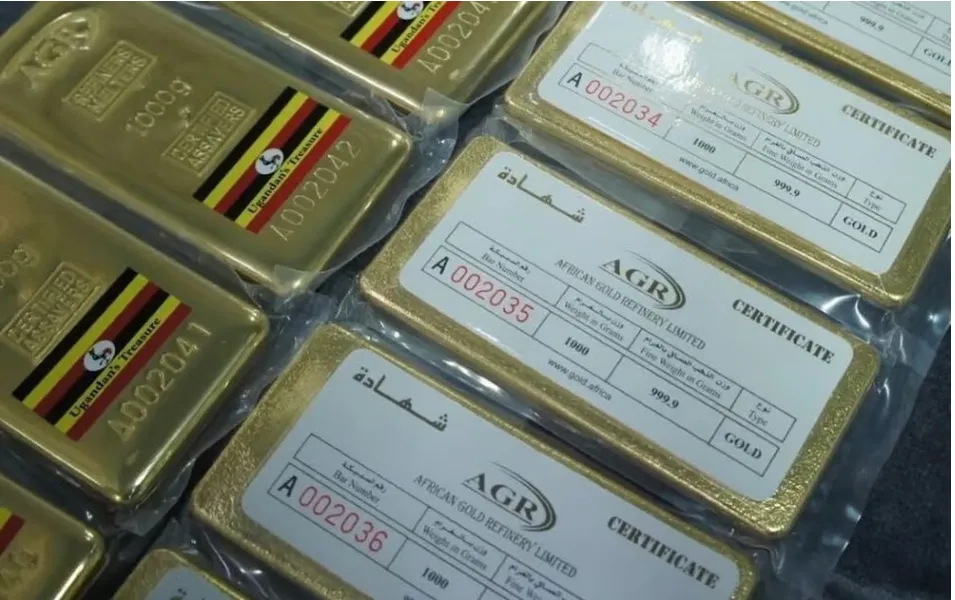
Long marginal in the African mining industry, Uganda has established itself in a few years as a major player in the regional gold trade, driven by the surge in world prices and the reorganization of export circuits in Africa. A spectacular trajectory, even though national gold production remains limited.
The figures are paradoxical. In 2025, Uganda's gold exports increased by 75.8% to reach 5.8 billion dollars, or almost 5 billion euros. The yellow metal has become the country's primary source of foreign currency, ahead of coffee, the historic pillar of its foreign trade, while Kampala is not identified as a major gold producer. This apparent discrepancy can be explained by well-known mechanisms of the global market, where processing and trading can weigh as much as extraction.
According to the Bank of Uganda, this sharp increase recorded in 2025 is partly linked to the surge in international prices. “Attractive gold prices have encouraged new players to enter the market, generating a significant volume of exports,” said Adam Mugume, executive director for research and economic analysis at the Central Bank, quoted by Reuters.
Exports that continue to grow
The bullish trend for gold in 2025 is an established fact. Last October, the precious metal crossed the symbolic threshold of $4,000 per ounce for the first time, before reaching an all-time high of $4,549.71 on December 26. Over the year as a whole, the price of gold rose 64%, its best annual performance since 1979, according to market data.
But the upward cycle is not enough to explain, on its own, the magnitude of the Ugandan figures. The value of the country's gold exports has been growing continuously for several years. If in 2015 they did not exceed 110 million dollars, they reached 336 million dollars in 2016, then around 400 million in 2017.
According to the Bank of Uganda, gold exports peaked at $2.3 billion in 2023 and then $3.3 billion in 2024. That year, they accounted for almost 40% of the country's total exports.
The heart of the model, transform and re-export
The main explanation lies not in the mines, but further down the economic chain. Uganda has positioned itself on what specialists call the downstream of the gold value chain, that is to say the stages of processing and trading of the metal, rather than on its extraction.
Concretely, the country has developed refining and trading capacities which allow it to process gold from neighboring countries, before exporting it in the form of bars ready to be sold on international markets. According to Stephen Turyahikayo, a specialist in the mining sector in the region, the commissioning of new refining capacities is one of the factors having contributed to the increase in exports observed in 2023.
In the gold trade, this positioning is decisive. Once melted and refined, the metal changes status. The “origin” retained in commercial exchanges then becomes that of the country where it is processed, which complicates the identification of its place of extraction in the statistics.
“If we take the example of gold imported from the DRC into Uganda, if this gold is refined in Uganda and subsequently re-exported for example to Dubai – this is what we have often observed – this gold will acquire Uganda as its origin and therefore will not be traceable to the DRC,” explains Yvan Schulz, co-author of a Swissaid study on the production of artisanal gold in Africa, in an interview with RFI.
A regional hub connected to global markets
The flows processed by Uganda largely come from neighboring countries, notably the eastern Democratic Republic of Congo (DRC) and South Sudan, before being sold on international markets. The United Arab Emirates, and in particular Dubai, constitute one of the main outlets for this African gold.
This platform role is not unique to Uganda. It is observed in several regions of the continent, where countries with low domestic production become major exit points thanks to their geographical position, their infrastructure and their regulatory framework.
According to Swissaid, in 2024, the United Arab Emirates will import 31 tonnes of gold from Uganda, compared to 14 tonnes a year earlier, as well as 19 tonnes from Rwanda. The same year, Dubai imported a declared 52 tonnes of gold from Togo, a country which, without being a major producer, benefits from its proximity to West African producers such as Burkina Faso or Ghana.
Recurring accusations, smuggled gold and conflict zones
Several NGOs and research centers have been warning for several years about the risks of integrating gold from areas affected by conflicts into the gold exported by Uganda.
Global Witness has already accused Ugandan companies and authorities of “turning a blind eye to the origins of gold”, citing a risk that it comes from conflict zones in the DRC or South Sudan. For its part, Swissaid believes that Uganda and Rwanda are “two countries which produce little gold but serve as a hub for smuggled gold originating in particular from the Democratic Republic of Congo, where it is partly linked to conflicts”
The companies singled out in these cases nevertheless dispute these accusations. They claim to have put in place due diligence procedures and believe that formalizing flows, leaving informal circuits, would ultimately improve the transparency of the sector.
Boost national production
According to Reuters data, Uganda produced only about 0.0042 tonnes of gold in 2023, or 135 ounces. For comparison, Ghana claimed production of nearly 4 million ounces, or around 124 tonnes, in the same year.
Kampala is nevertheless beginning a transition. In 2025, the country inaugurated its first large-scale industrial mine, led by a Chinese group in the east of the territory. Ultimately, this project should produce around 1.2 tonnes of gold per year, according to forecasts.
In 2022, authorities have indicated that Uganda's subsoil will host gold ore deposits estimated at around 31 million tonnes, based on exploration work carried out over two years. They estimate that these resources could make it possible to produce more than 320,000 tonnes of refined gold. Figures which, however, remain difficult to assess independently, and which have not, at this stage, triggered a perceptible rush of investors towards the local gold sector.