EU and India close to reaching trade deal
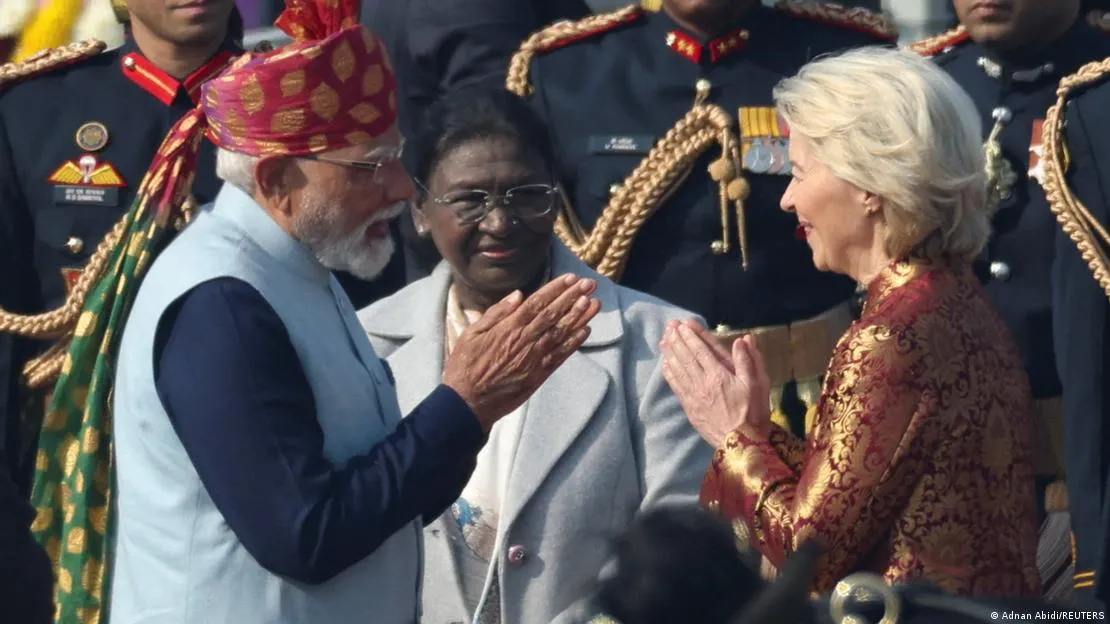
The EU and India are set to conclude the "mother deal" and a defense pact aimed at distancing India from its close political and military ties with Russia.
The leaders of the European Union (EU) attended the military parade marking Republic Day in India on Monday (26.01.26), guests of honor of the government in New Delhi with which they are to conclude an ambitious free trade trade treaty.
In the gallery, the strong man of the most populous country on the planet - 1.5 billion inhabitants - was surrounded by the President of the European Council Antonio Costa and his Commission counterpart Ursula von der Leyen.
The EU and India have been discussing a free trade treaty for more than 20 years, the conclusion of which was accelerated by the tariff war imposed by US President Donald Trump.
At a high-risk summit in New Delhi this week, the EU and India are expected to finalize this free trade agreement and sign a new security and defense partnership, the third such agreement between the EU and an Asian country after Japan and South Korea.
“The EU and India will consult on their respective defense initiatives, including through exchanges on issues related to the defense industry,” according to a draft document on the security and defense partnership seen by the Reuters news agency.
“Despite long-standing arguments for a closer partnership, including joint competition with China and trade incentives for both sides, it was Russia's invasion of Ukraine and Trump's punitive tariffs that gave new impetus to the relationship,” said Praveen Donthi, a senior analyst at the New Delhi-based International Crisis Group.
EU and India chart ambitious course
The EU and India are expected to conclude negotiations on Tuesday (27.01) on the trade deal that would create a market of almost two billion people representing a quarter of global GDP. Ursula von der Leyen and Indian Prime Minister Narendra Modi will also participate in the first EU-India business forum, alongside more than twenty major industrialists from both parties.
The EU and India are also expected to launch a new cooperation framework on labor mobility. Through this, the EU hopes to attract highly qualified and seasonal workers from India. “Of course, depending on the needs of the labor market in the European Union,” said an EU official, speaking on condition of anonymity.
What are the expectations of the EU and India?
"Europe wants to do business with today's growth centers and economic powers of this century," Ursula von der Leyen said on Wednesday (21.01) at the World Economic Forum in Davos, calling the trade deal with India "the deal of all deals."
According to EU data, the European Union is India's largest trading partner; merchandise trade reached a value of €120 billion in 2024, or 11.5% of India's total trade. By 2030, India is expected to become the world's third largest economy after China and the United States.
The EU hopes India will drop its high tariffs on imported vehicles, which currently exceed 100%, and boost the European auto industry in the face of Chinese competition. And, as Indians move up the ladder of economic mobility, Europe's liquor industry stands ready to quench their thirst for fine wines and spirits. As part of the trade deal, India is expected to remove its extremely high alcohol tariffs, which reach 150% on imported wines.
Last year, as part of its free trade deal with the United Kingdom, India agreed to remove tariffs on cars and alcohol, but gradually, to reduce the impact on domestic manufacturers.
For its part, India has demanded lower standards for its pharmaceutical exports and the same duty-free access for textiles as that granted by the EU to its Asian neighbors like Pakistan and Bangladesh. New Delhi hopes this will offset the impact of US tariffs, which have been particularly damaging to India's garment sector.
India also hopes to send more professionals to the EU for job opportunities and is seeking commitments for joint production in the defense sector.
Overall, India aims to increase its exports to the bloc, which currently account for just 2.5% of total EU imports, and strengthen the integration of its supply chain.
What are the sticking points?
As with the recent trade agreement between the EU and Mercosur, agriculture has become a major concern. Nearly half of India's workforce is employed in agriculture, and India fears that European agricultural products will replace Indian products and threaten the livelihoods of millions of people. This has made New Delhi reluctant to grant the EU the kind of market access it seeks.
This subject is also very politically sensitive for New Delhi. In 2021, when massive farmer protests forced Prime Minister Narendra Modi to withdraw a series of agricultural reforms, it was seen as a rare public political setback for the powerful leader.
But the EU, shaken by protests by its own farmers against the Mercosur deal in South America, is under enormous pressure to find new markets for European agricultural products.
Brussels is also reluctant to grant some Indian agricultural exports unfettered access to EU markets. Last month, the bloc reportedly decided to limit rice imports from India and other Asian countries to protect domestic rice farmers and millers.
Steel is another major point of contention, especially as the EU doubled tariffs on foreign steel in October and halved the quota for duty-free imports. The tariff hike comes on top of a new carbon tax that will make Indian steel exports less competitive.
The EU says its carbon tax aims to reduce its global carbon footprint, but Indian diplomatic sources say both measures are protectionist.
And yet both sides agree that the only solution is to move forward.