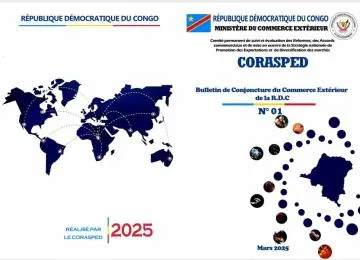
Foreign Trade Bulletin of the Democratic Republic of the Congo (2000–2023)

The Government's vision for the trade sector is to make the national economy "more competitive at the national, regional, and international levels in order to improve its standing regarding integration into international trade, contribute to the population's well-being through the achievement of the Sustainable Development Goals (SDGs), and foster the DRC's emergence by 2030," notes the performance document from the DRC's Ministry of Foreign Trade. Foreign trade is a key sector of the Congolese economy. While the DRC possesses exceptionally rich land and subsoil resources, its economy remains heavily outward-oriented. Since independence, the structure of trade has been characterized by a dominance of raw material exports—primarily minerals—and by diversified yet growing imports, reflecting an economy that is still largely unindustrialized and poorly integrated into global value chains. Several structural constraints explain this trend, notably limited export diversification, inadequate transport and communications infrastructure, a lack of transparency in natural resource management, trade and regulatory barriers, limited access to finance, and low value addition resulting from a lack of local processing and a technological lag.
The Government's vision for the trade sector is to make the national economy "more competitive at the national, regional, and international levels in order to improve its standing regarding integration into international trade, contribute to the population's well-being through the achievement of the Sustainable Development Goals (SDGs), and foster the DRC's emergence by 2030," notes the performance document from the DRC's Ministry of Foreign Trade. Foreign trade is a key sector of the Congolese economy. While the DRC possesses exceptionally rich land and subsoil resources, its economy remains heavily outward-oriented. Since independence, the structure of trade has been characterized by a dominance of raw material exports—primarily minerals—and by diversified yet growing imports, reflecting an economy that is still largely unindustrialized and poorly integrated into global value chains. Several structural constraints explain this trend, notably limited export diversification, inadequate transport and communications infrastructure, a lack of transparency in natural resource management, trade and regulatory barriers, limited access to finance, and low value addition resulting from a lack of local processing and a technological lag.