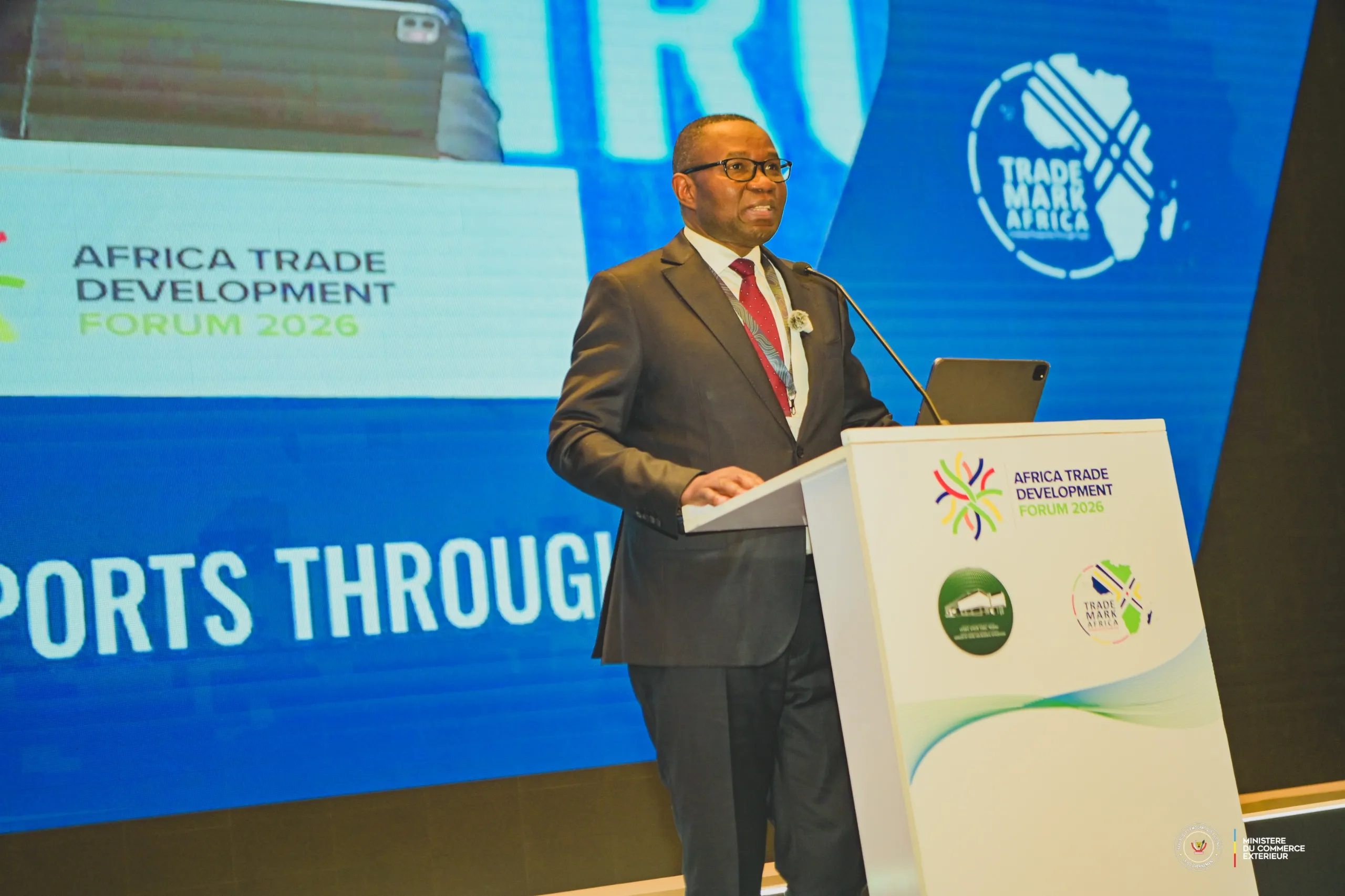
FORUM ON TRADE DEVELOPMENT IN AFRICA Addis Ababa, 23 November 2026
WHY INVEST IN THE DRC?
Your Excellencies, African Ministers responsible for trade
Ladies and gentlemen, industry leaders and business executives
Allow me to extend my greetings to all the leading figures of the continent gathered here today in Addis Ababa to discuss a thought-provoking theme relating to the development of trade in Africa.
Indeed, the DRC is no longer merely the world’s reservoir of raw materials; it is becoming the indispensable processing hub for Africa and the world.
Waiting until everything is perfect to invest in the DRC means accepting that you will arrive after the battle is over.
Look at the mobile phone in your hands, in your pockets, or the electric car parked outside this hotel in Addis Ababa. Without the DRC’s cobalt, coltan and copper, the global energy transition would come to a screeching halt first thing tomorrow morning.
Yet, every time I utter the word “DRC” at an economic summit, I see two reactions in the room: fascination with our resources… and hesitation in the face of risk.
Let’s be blunt: if you’re still looking at the DRC through the rear-view mirror of past crises, you’re missing out on the greatest industrial opportunity of the decade.
We’re here in Addis Ababa to talk about competitiveness, standards and intra-African trade. Yet Africa will not win the battle for global trade by exporting raw materials.
We’ve learnt our lesson.
Look at the facts, not the rumours:
1. Resilient economic growth exceeding 5 per cent a year, driven by a domestic market of over 100 million consumers;
2. Inflation brought under control and direct investment now running into billions of dollars each year.
3. And above all, a shift in approach: we are moving from extraction to local processing. From the deep-water port of Banana to the Lobito Corridor and on to the ports of the Indian Ocean, the trade routes linking the heart of the continent to global markets are being redrawn right now.
So, why invest now rather than in five years’ time? Because the rewards belong to the pioneers across three specific value chains:
1. Industrial and mining processing: We no longer wish to export raw ore; we are building refineries and value chains for batteries. Investing in subcontracting, logistics and quality standards in the DRC means becoming part of the most strategic link in the global industry.
2. Alternative agribusiness: With its 80 million hectares, the DRC aims to process cocoa, coffee, cassava and palm oil locally..
3. Energy and digital technology: With an energy deficit to be addressed and an extremely young population, decentralised solar power, fintech and connectivity are not mere gadgets: they are vital needs offering a rapid return on investment.
Ladies and gentlemen
Investing in the DRC requires a rigorous approach. It calls for strong local partners, adherence to quality standards and a long-term vision.
But ask yourselves this: in ten years’ time, when the AfCFTA’s value chains are running at full capacity, will you want to be the one who built the factory at the heart of the continent… or the one buying the finished product from your competitors? The path is clear.
The DRC has introduced several reforms, notably: the One-Stop Shop for business start-ups, the One-Stop Shop for foreign trade to streamline procedures, and the Special Economic Zones (SEZs)…
Today, the country has been removed from the FATF’s ‘grey list’ – a historic step forward that will restore investor confidence and facilitate transactions by our banks.
For President Félix-Antoine TSHISEKEDI, the train has set off. Hop on board in Kinshasa and in the 25 other provinces.
If you don’t board the train now, it will be too late tomorrow.
Thank you.
RECENT ARTICLES