Political institutions
- European Commission: proposes and enforces the laws.
- European Parliament: the democratic body representing the citizens.
- Council of the EU and European Council: major political decisions.
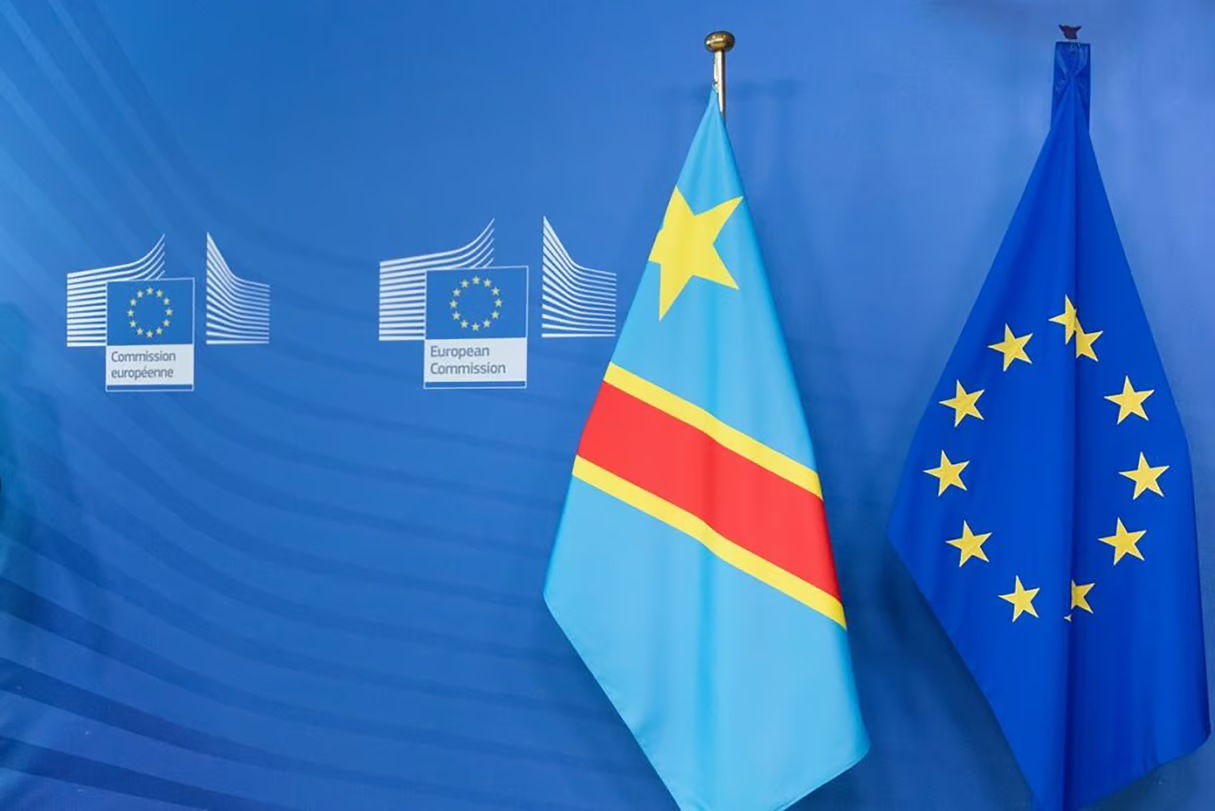
Democratic Republic of the Congo — European Union: a major economic, commercial and institutional partnership.
A unique model of political and economic integration
The European Union (EU) is a political and economic union bringing together 27 Member States. Created in the aftermath of the world wars, it aims to establish peace, shared prosperity and reinforced cooperation. With its 447 million inhabitants, the EU is today a pillar of international trade and a strategic partner for many developing countries, including the Democratic Republic of the Congo (DRC).
From the European Economic Community to the European Union
The EU has its roots in the European Economic Community (EEC), created in 1957, with the objectives of preventing conflicts through economic interdependence, creating a common market and ensuring the free movement of goods, capital, services and people.
In 1993, the Maastricht Treaty founded the European Union, which extended its areas of competence to foreign policy, security and justice and introduced a single currency: the euro.
The main institutions of the European Union
The European Union as a major player in global trade
According to the reference sources, the European Union is presented as the world's second largest economic power. It is a major player in the pharmaceutical, agricultural, automotive and technological sectors.
The reference sources also present the EU as a major trade and investment partner in several African countries, including the DRC, as well as an important provider of official development assistance.
Trade cooperation and development
Through the Cotonou Agreement and subsequently the Samoa Agreement, the EU supports ACP countries — Africa, Caribbean and Pacific — through various cooperation mechanisms.
Cooperation and support to the DRC
The reference sources present several areas of cooperation between the European Union and the Democratic Republic of the Congo, notably in the institutional, commercial, environmental and security fields.
Capacity building and trade development
Training programmes funded by the EU are presented in the reference sources as having helped improve the technical and administrative skills of the ministry's staff.
The EU supports the alignment of Congolese trade regulations with certain European and international standards.
The reference sources also mention European technical assistance aimed at strengthening the DRC's capacity in trade negotiations, particularly around the EPAs.
Opportunities for Congolese exports
The reference sources indicate that the DRC benefits from the Everything But Arms (EBA) regime, presented as allowing Congolese products to be exported to the EU duty-free and helping to diversify exports.
Several European projects are presented in the reference sources as supporting the digitalisation of customs and trade procedures in order to facilitate exchanges and help fight corruption.
Areas highlighted in the EU – DRC partnership
Strengthening the technical and administrative skills of the institutions involved in external trade.
Harmonisation of trade frameworks, technical support and improved negotiation capacities.
Support for the digitalisation of trade and customs procedures to facilitate exchanges.
The issues identified in the reference sources
Developing trade capacities, diversifying exports, adapting to international standards and integrating into value chains are major issues in the trade relationship with the European Union.
The partnership with the European Union spans several dimensions: trade, institutional strengthening, technical cooperation, capacity development and the integration of the DRC into global value chains.
Cooperation serving external trade
According to the reference sources, the European Union remains an important partner for the DRC. Its cooperation with the country goes beyond the sole trade framework and covers the institutional, technical, environmental, security and capacity development dimensions. For the Ministry of External Trade, this cooperation contributes in particular to strengthening trade capacities, improving regulatory frameworks, promoting exports and integrating the DRC into global value chains.